PlanSea has in the past undertaken development initiatives & POCs with a variety of operators in our journey to being able to offer a commercial product. These include Nexen (CNOOC), BP, Equinor, and Total in the UKCS and, most recently, ExxonMobil in Nigeria.
We have modelled operational scenarios ranging from one or two installations and vessels, operating from a single port, to large multi-operator scenarios, for example with six operators in the UK Central North Sea.
Software Approach, Functionality & Scope
PlanSea has developed a robust and scalable approach to marine logistics planning, based on cutting-edge AI research and extensively validated on large case studies with North Sea operators.
PlanSea owns all IP related to our current software.
Our approach uses discrete event simulation (DES) to build an operational computer model of logistics resources, tasks, durations and locations. The model includes vessels (operating and maximum speeds , draughts, deck and bulk tank capacities, pumps and rates), supply bases (locations, loading and pumping rates, facilities), installations (location, demand / consumption rates, multi-platform capacities, operating restrictions and waiting times) the marine environment (sailing times and conditions, vessel routing, restricted areas) and operational tasks (platform supply, drilling support, refueling, tank cleaning, etc.).
The software determines an appropriate mix of vessel types and sizes to meet demand for installation supply, taking into account seasonal variation in demand and optimising for cost and emissions efficiency. The approach used can also be directly applied to infield logistics vessel schedule design, because it uses a comprehensive computational model which simulates vessel operations including port and installation activity and sailing routes and times. The software allows multiple scenarios to be explored and is capable of modelling large scale scenarios with dozens of vessels and platforms operating from multiple ports. Outputs include recommendations for fleet size, vessel types and sailing routes, projected costs, fuel usage and emissions.
The software is highly scalable to allow use across the operational spectrum from small to extremely large/busy basins on a single operator or collaborative operators group basis.
The approach taken also uses proprietary AI to create optimised operational plans that meet projected demand and all operational constraints while minimising cost, fuel usage and emissions. Plans produced by the AI are simulated using the operational model.
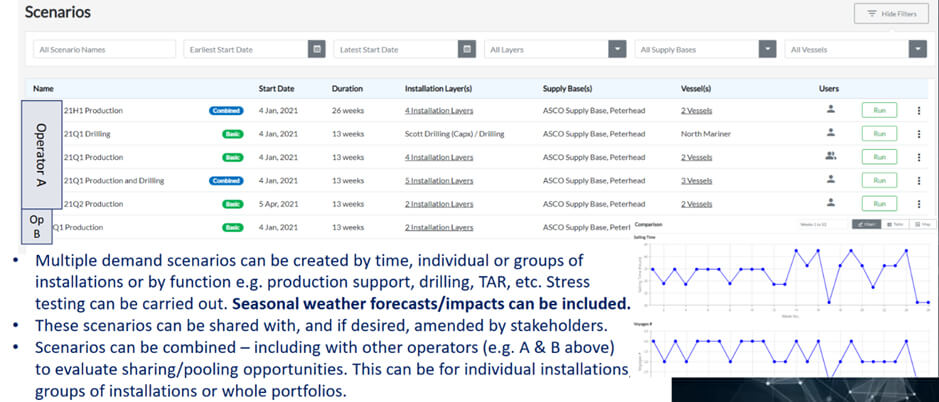
The model outputs detailed sailing routes, timings and task schedules for the vessel fleet, over periods from a few weeks to two years or more ahead, as well as projected operational KPIs and other analytics. Once the operational model is constructed, PlanSea software can be used to develop marine logistics plans, exploring a variety of scenarios and assumptions, assisted by the AI. This includes stress-testing options, producing financial budgets and emissions forecasting.
Screenshots from the PlanSea Marine Logistics Optimisation software :
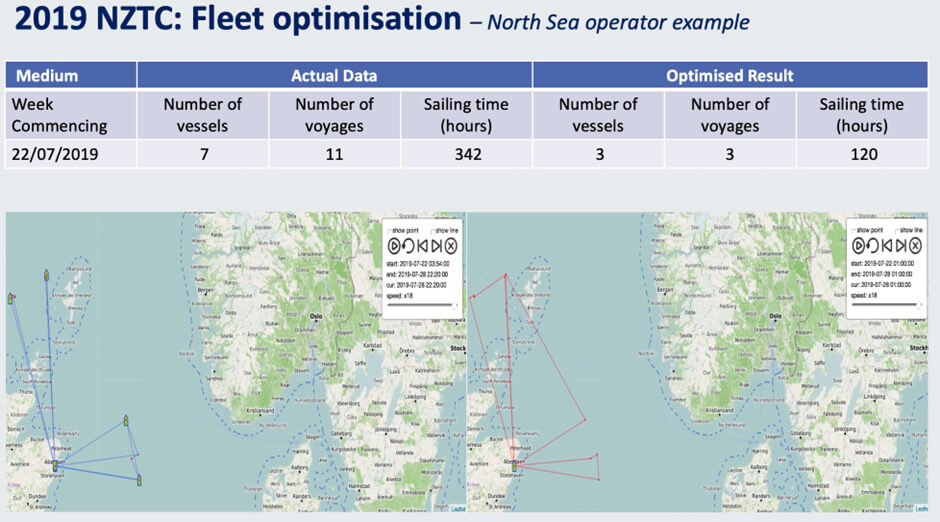
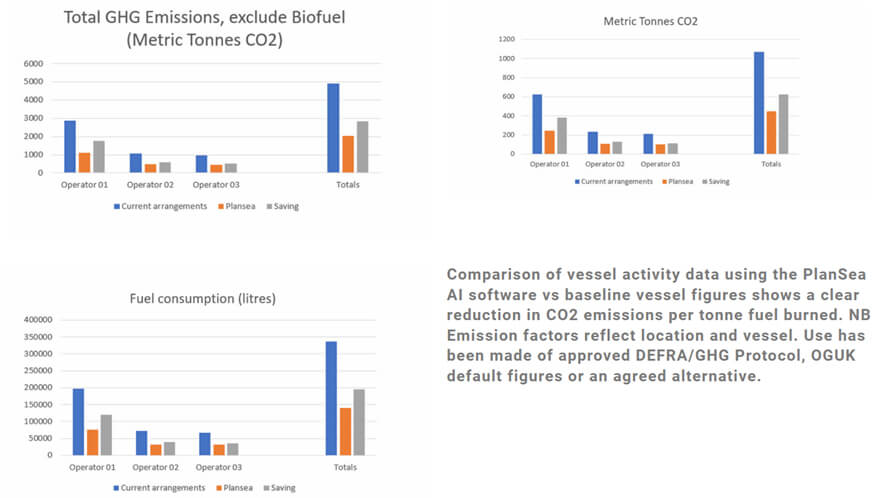
Three operator example showing actual data and routings compared to savings available through optimisation using PlanSea’s AI-based software.
Tactical Planning – Vessel Movement Port, Installation & Infield
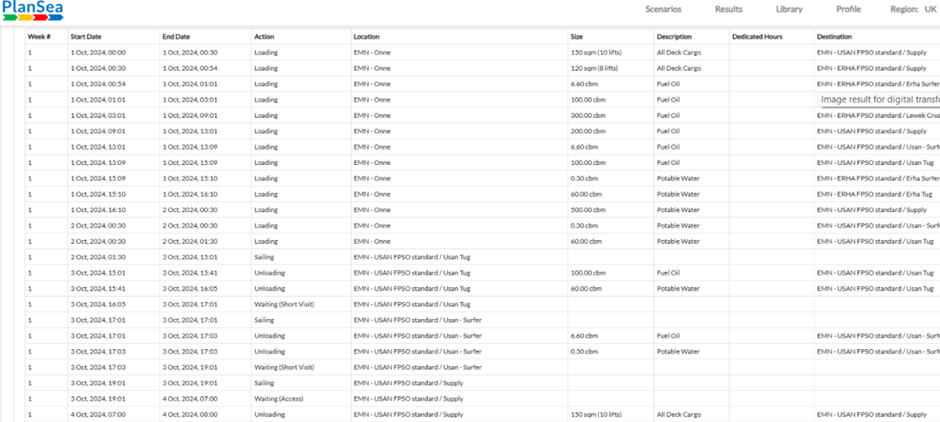
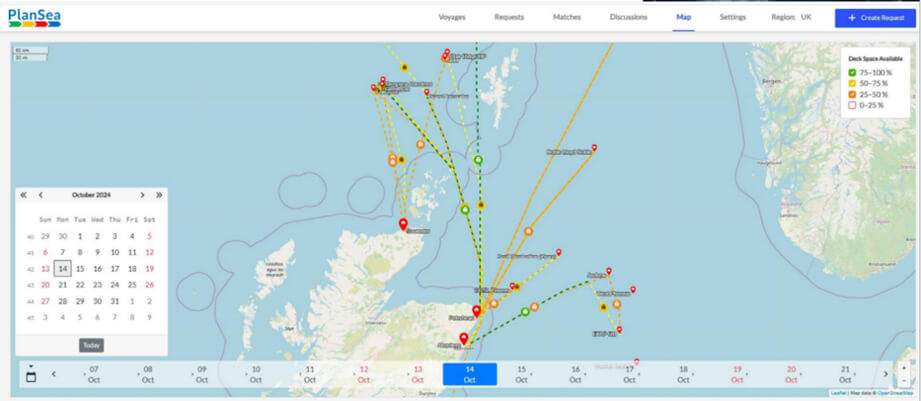
The PlanSea model outputs detailed sailing routes, timings and task schedules for the vessel fleet, over periods from a few weeks to two years or more ahead. The image below sets out planned activities, routing and timings from one of a number of recent POC scenarios being evaluated.
Our team have extensive experience in dynamic real time adaptive algorithms that can support operations management in real time and PlanSea has products in development that can form part of real time logistics execution systems:
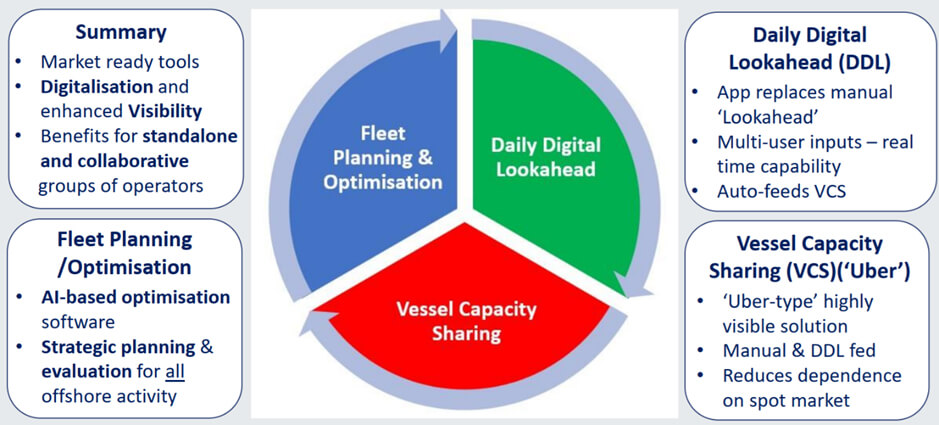
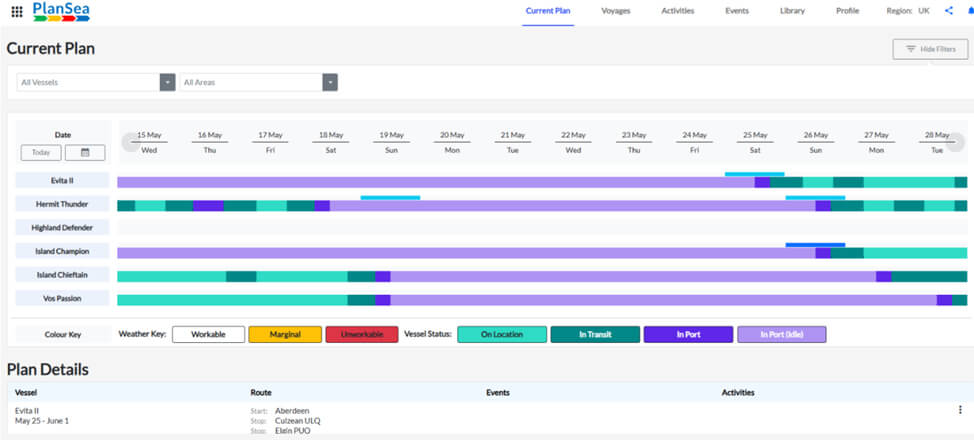
Daily Digital Lookahead provides a ‘real time’ view of vessel operations, showing progress to plan, communicating changes (delays/re-routing etc) to operational stakeholders in real time.
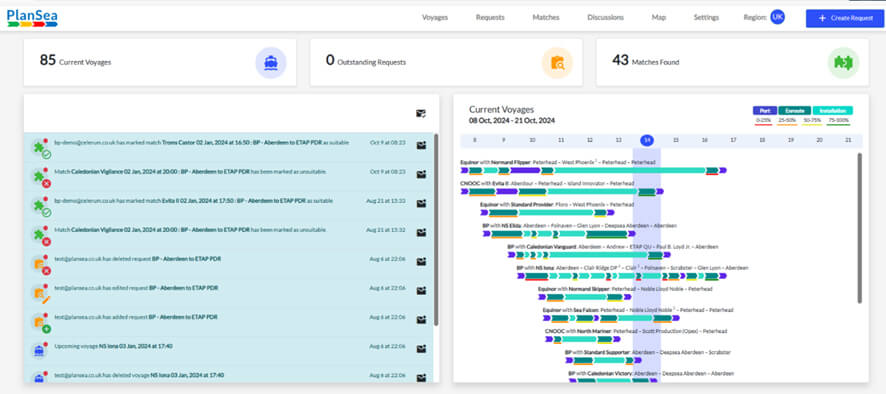
Capacity sharing – facilitates real time vessel capacity sharing with other subscribed operators or discrete operator internal groups across a basin.
Digital Daily Lookahead – Main Screen
The objective is enhanced, online visibility for approved stakeholders removing the need for email circulation of pdf updates.
Input authority available for both onshore and offshore personnel.
Data is also captured for analytical purposes.
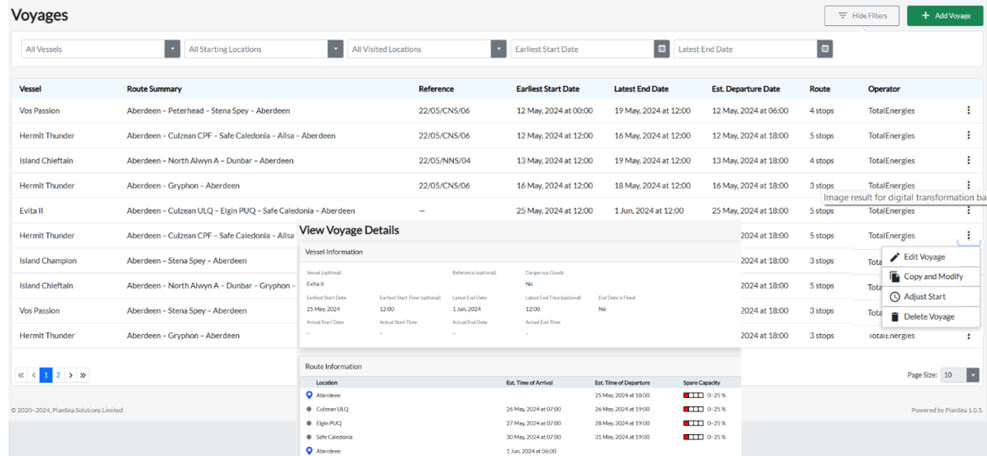
Digital Daily Lookahead – Drill Down Capability
Detailed route & voyage information is available. Events impacting vessel availability is captured and used in scheduling.
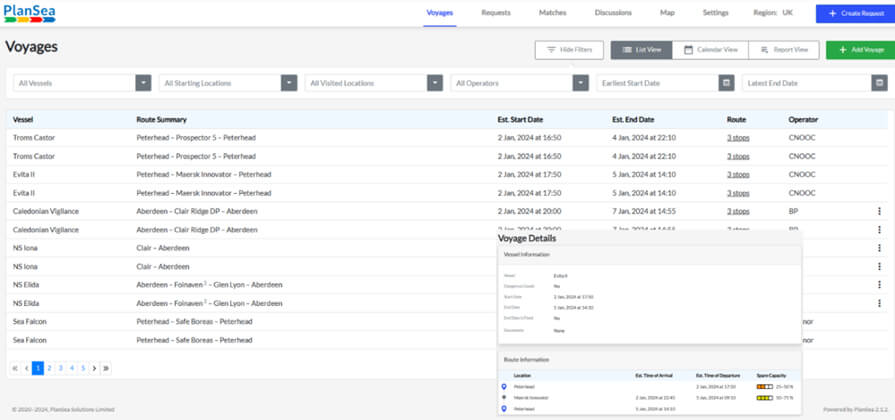
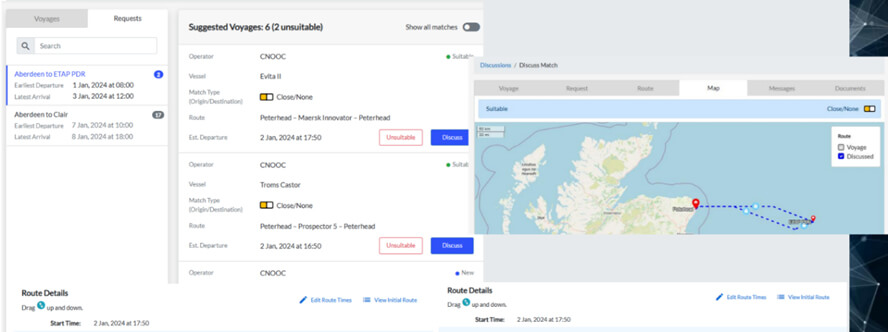
Vessel Capacity Sharing Application
Capacity sharing – facilitates vessel capacity sharing with other subscribed operators or internal groups across a basin.
Examination of options and discussions on routing, etc are facilitated within the application :
Emissions Analysis/Forecasting
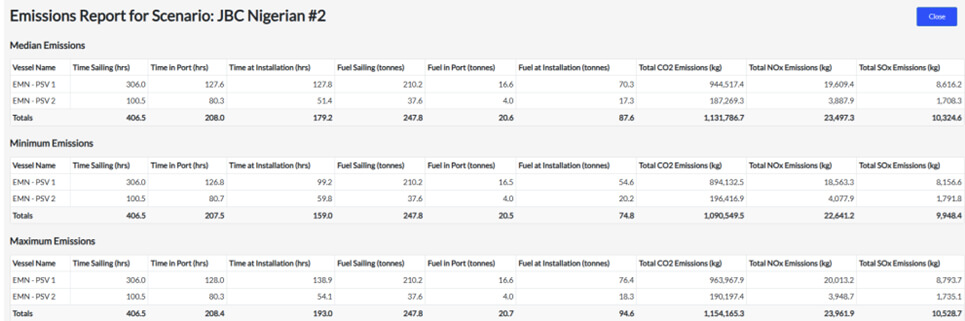
PlanSea has worked with Vysus to utilise complementary emissions expertise to calculate accurate metrics of emission reductions and forecasts of likely emissions resulting from future potential scenarios requiring evaluation.
This analysis is based on data from the “Multi-user and pooled scenarios (3 Operators; multi-port annual activity)” set out previously. Data below is from a recent POC study.
This website uses cookies to improve your experience. We'll assume you're ok with this, but you can opt-out if you wish. Cookie settingsACCEPT
Privacy & Cookies Policy
Privacy Overview
This website uses cookies to improve your experience while you navigate through the website. Out of these cookies, the cookies that are categorized as necessary are stored on your browser as they are essential for the working of basic functionalities of the website. We also use third-party cookies that help us analyze and understand how you use this website. These cookies will be stored in your browser only with your consent. You also have the option to opt-out of these cookies. But opting out of some of these cookies may have an effect on your browsing experience.
Necessary cookies are absolutely essential for the website to function properly. This category only includes cookies that ensures basic functionalities and security features of the website. These cookies do not store any personal information.
Any cookies that may not be particularly necessary for the website to function and is used specifically to collect user personal data via analytics, ads, other embedded contents are termed as non-necessary cookies. It is mandatory to procure user consent prior to running these cookies on your website.